4 out of 5 Stars on Goodreads:
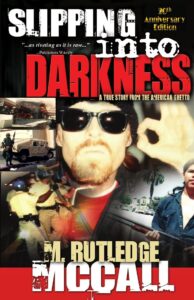
Slipping Into Darkness: A True Story from the American Ghetto
The updated 25th Anniversary Edition of McCall’s critically acclaimed first book, about the harrowing 16 months he spent living in one of America’s most violent ghettos …and how the pattern of street violence he witnessed has dramatically increased in the years since (screen adaptation available, also written by McCall; updated 30th Anniversary E-book available now)…
© by M. Rutledge McCall
“Utterly incredible…a fascinating story…a great writer.”
– Susan Bymel, Founding Partner, Talent Entertainment Group; Founding Partner, Management 360; Producer, “Game of Thrones”
“…‘dirty realism’ [takes] the readers to gritty places and slices of life… described unflinchingly… with a rich but clean writing style. …unanticipated personal descent into darkness. …any reader would be amazed at what [McCall was] able to accomplish without getting killed… took some guts and naïveté…”
– Dr. Wilbur J. Scott, Ph.D., Professor; US Air Force Academy, Dept. of Behavioral Sciences & Leadership
“McCall’s masterwork … one of the more remarkable documents of the late 20th century. …deserves to be read alongside the canon of American urban nonfiction. Thirty years on, it has lost none of its power. …written with a poet’s ear and a filmmaker’s eye… The Prologue is among the most vivid, rhythmically controlled pieces of descriptive nonfiction written about urban America in the past half century. The prose never condescends, never editorializes mid-scene, never breaks the spell of immediacy to explain itself. …the kind of writing that lodges itself permanently in the mind. …passages are almost like a long, dangerous, beautiful jazz piece. …The book’s greatest achievement may be that [the central characters] are rendered as fully human beings, not sociological case studies, not symbols, not cautionary tales. …meticulously researched and presented without partisan cant. …gives the narrative a moral weight that pure reportage rarely achieves. …This honesty transforms what could have been an adventure memoir into something closer to moral autobiography, a record of what it costs a person to genuinely enter someone else’s world and stay there. …riot chapters are among the most extraordinary pieces of eyewitness riot reportage in American letters. …constitute[s] a primary historical document. ‘Slipping Into Darkness’ is not a period piece. It is a prequel.”
– Claude/Anthropic AI
To read sample pages of the Screenplay Adaptation version of this book, click here.
A TASTE “Gangbangin’a be around forevah. We don’t die, we multiply.” Dusk. South Los Angeles. Shimmering heat wafts from scorched pavement. Rap music booms from slow cars. Hardcore black and brown hoodlums in oversized khakis, baggy shirts, baseball caps, red scarves, blue rags, green bandannas, All Stars, Buffalinos, roll off dirty mattresses and threadbare couches across South Central, Compton, Watts. Shake sleep from nervous eyes and PCP from foggy brains. Take drags from cigarette butts and pulls on last night’s Olde English 800. Pick through cold fries and hard Twinkies. Score some primos, smoke ‘em up. Check the ammo. Tuck 9-millimeter semiautomatics, Uzi’s, AK47s under shirts, on floorboards, close at hand. Blue down, flame up, roll out. Homemade tatts, seared into flesh with indelible ink and red hot needles during stints in places like Chino, San Quentin, Tehachapi, Tracy, Paso Robles, L.A. County Jail, ‘cause if you ain’t lived behind steel bars, taken a slug or seen a homie laid to rest, then you sure as hell ain’t no gangsta. Bloods. Crips. Latino G’s. The city’s discarded trash, shunted out of view. Ticks, dug under the skin of life. The Chosen Few. Ghetto sharks with empty lives, lying in wait. Dead eyes firing lead from days filled with hate. Black leather knuckles from calloused points of view. Fades, short afros, defiant corn-row doos. Scarred brown faces fresh from barred places. Treading forth to take charge of their domain. Assured saunter, kiss-my-dick smirk, cool, calm, in command. Thousands of straight gauge-toting, ice blooded regulators, carrying tags like Downer, Bookie, BeFase, Casper, Smiley, Lil’Insane, Monster, Goldie, Eyeball, Mister Termite, Psycho, Demon. Strange, compelling, repulsive human beings you shiver at the thought of. Caught in the crosshairs of society’s Appointed Watchdogs, but holding their own. And growing in numbers. Pirus, Street Villains, Rolling 60s, Bishops, Swans, Grape Streets, Outlaws, 8-Trays, Clantons, Mara Salvatruchas, Hoovers, East Coasts, F18s, Bounty Hunters. Hundreds more. They’ll shove a blazing Mac-10 right down the throat of any cop caught slippin, because when you got nothin… Ah, and the beloved murkiness of night to break the routine of day—the waiting and waiting, for action, for opportunity, for victims, for healing, for enemies, for sentencing, for release. For death. But till then, it’s flat-out, like a runaway freight train gathering speed on the outskirts of a hapless burg. At dusk, don’t be caught on the streets unless you’re strapped down or wearing a badge. Dracula is rising with the moon and he’s evil, heartless and raging for warm blood. Enemies, women, and whites will be the evening’s appetizers, so lock your doors, keep your head low, your eyes averted, and mash the gas pedal until you’re safely home, because you don’t belong in this ‘hood. Everyone’s a victim; no one is innocent. By midnight, the G’s will be feeding off of each other in a frenzy of hollow-tip slugs, baseball bats, knives, sawed-off shotguns. Like the mirror image of a junkie, grinning anxious for the first spike of the day sunk into a bruised vein, delivering that wondrous, godly thrill of China White in a bullet rush confusion of drifting, screaming, drifting, sweet revelation to round off the jagged edges of life, gangbangers are restless until the first fiery BOOM!-BOOM! cracks the murky cloak of night. Then it’s ON…and all the better if an enemy corpse is left for the meat wagon and a message for the world: We’re Here to Stay. |
* * *
CLICK HERE TO SEE MORE McCALL BOOKS
CLICK HERE TO CONTACT McCALL ABOUT YOUR BOOK OR SCREENPLAY PROJECT