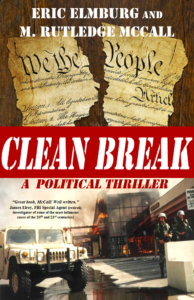
Clean Break

Written by M. Rutledge McCall based on an original story idea by Eric Elmburg, this timely political thriller feels uncomfortably real in light of the violent, divisive politics gripping the U.S. today… and imagines what could be in store for America (no screen adaptation available at this time)…


“Great book! Well written.”
James Elroy, FBI Special Agent, retired; investigator of some of the most infamous cases of the 20th and 21st centuries

Feels like ‘Homeland’-meets-‘Yellowstone’… a political scenario that seems frighteningly real. …draws you in and keeps you transfixed. …McCall (who wrote the book from an original story idea by Elmburg) paints rich, compelling word pictures. …a maddening cliffhanger.”
– Shane Baéz, President, CAM Artistic Management, Los Angeles


SAMPLE CHAPTER


In the basement of the White House, in the Situation Room, officially known as the National Military Command Center and nicknamed The War Room, President Cole is being briefed by Chief of Staff McMaster, Joint Chiefs Chairman Poindexter, DIA Director Evans, Political Affairs Assistant Chief Johnstone, Press Secretary Barder, Homeland Security Director Rogers, DCI Davenport, FBI Director Davis, National Security Adviser Milton, and NSA Director Kane.

The mood is tense, angry.

“So, as far as conventional warfare, sir,” Evans is telling Cole, “we have overwhelming superiority on both ground and air. He won’t know what hit him.”

President Cole looks at Poindexter, says, “What’s the final option after conventional warfare?”

“Worst case scenario, Mr. President?” Poindexter replies, then answers himself, “A limited payload, targeted nuclear strike.”

“We’re not going to nuke them, for God’s sake,” Cole responds. “They’re our citizens.”

“Not what Cannon says, not anymore,” Rogers quips.

McMaster says, “We might want to hear this out, sir. Because it’s important that we understand Cannon’s options and capabilities too.”

“Cannon has nukes?” Cole says.

Poindexter nods. “Sure does, Mr. President. Armed Minuteman-three LGM-30Gs at the 91st Missile Wing, Minot AFB, North Dakota. In Ellsworth in South Dakota, he has some—”

Used to have some old LGM-30Bs,” Rogers cuts in. “Those were retired, weren’t they?”

“Nope. Still hot,” Poindexter says.

“Great,” Rogers says. “Cannon has what, the fourth most powerful nuclear arsenal on the planet?”

“Probably closer to third,” says General Milton.

McMaster looks at Poindexter, asks, “Is the 625th Strategic Op Squad still operational at Offutt AFB, Nebraska?”

Poindexter says, “Still operational but they’re targeting, not launch.” He looks at the president and adds, “But Mike’s right, sir. We need to discuss the nuclear procedure, so we’ll know what Cannon is capable of and what he might do, so we can respond or initiate appropriately.”

“We know what he’s capable of—he just did it,” the president says. “Can you believe the balls, quoting Lincoln in defense of splitting the nation in two?”

“Clever, actually,” Johnstone says, adding, “Why doesn’t he just run for the White House in a couple years?”

McMaster says, “He said, quote, he does not want to be part of the problem, quote unquote.”

Cole says, “Well he is the problem now. Get on with it, Paul.”

Poindexter stands, steps to the side of a chart on a screen, points with a red laser as he speaks to the group.

“As of a few years ago, the US had 4,500 nuclear warheads under our control.”

“Not anymore, apparently,” Cole says. “Continue.”

“The procedure for nuclear engagement is as follows: first, the president, as Commander in Chief, has the sole authority to authorize the use of nuclear weapons.”

“Tell Cannon that. Go on.”

“Before initiating a nuclear action, the president convenes a conference with his cabinet, the joint chiefs, civilian advisers in Washington, ranking committee chairmen in the House and Senate, and top national leaders around the world, to discuss options.”

Cole shakes his head, says, “You ever been to a meeting like that, Paul? It takes an hour just to decide where everyone is going to sit—and that’s just on a conference call.” He looks at Evans, says, “Does Cannon have operational control of his nukes?”

“Unfortunately, yes,” DIA Director Evans says. “His tech team fully overrode and co-opted them a little over 12 hours ago.”

Cole shakes his head, looks at the table, says nothing, thinking.

“Why the fuck didn’t any of you geniuses see this coming!?” he suddenly bellows.

Nobody says a word as he glares at them.

Finally, McMaster says, “I guess nobody expected a former highly decorated Marine Corps special ops officer to… do something like this, sir. He convinced us all he was doing was going after your job.”

Cole shoots McMaster a look. McMaster shrugs.

Cole sighs, turns back to Poindexter, says, “Go on.”

Poindexter takes a breath, continues. “In the White House, sir, the call would take place here in the Situation Room. If you happen to be traveling, then you’d be joined in on a secure line. A key participant in that meeting would be a Pentagon DDO—deputy director of operations—one of the officers in charge of the National Military Command Center.”

“You’re repeating this from memory, Paul.”

“Beg pardon, sir?”

“We’re in the National Military Command Center right now, Paul. The War Room?”

“Oh. Yes sir. Of course, sir. I am repeating it all from memory. Anyway, this DDO is the person responsible for generating, prepping, and ultimately relaying emergency action messages to launch control centers, nuclear sub captains, and recon aircraft and battlefield commanders, after a nuclear launch order is given by the president. The head of all US strategic nuclear forces at Strategic Command, in Omaha, Nebraska, would—”

“Hold on, hold on. Nebraska?

“Yes sir.”

“Doesn’t Cannon have Nebraska too?”

“Yes, sir.”

“You’ve got to be kidding me,” Cole says.

He sits silently for a moment. The room goes quiet.

“Continue,” Cole says, now in a quieter voice as the ramifications of Cannon’s preparedness begins to fully settle over him.

Poindexter says, “Anyway, you would then ask the head of US strategic nuclear forces at Strategic Command to brief you on strike options. That briefing would take as long as you need.”

“Yeah, and meanwhile Cannon’s missiles are on their way while I’m trying to decide what to do with mine.”

“Well, sir, you would need to decide on whether to order a counterstrike. But an initial briefing could last only ten seconds, long enough for you to give a go-ahead.”

Cole shakes his head, “And if I’m launching on faulty intel?”

“Well… there’s always that remote possibility, sir. Anyway, next, if you give the order to launch, the Pentagon must comply with your orders. But first, they would have to verify your order. You know, to make sure it’s you, that you’re not being coerced, that it’s the real deal. That sort of thing.”

“How do they verify it’s me?”

“The senior officer in the Pentagon’s war room would read you what’s called a challenge code. This is a two-letter code spoken in the military alphabet, such as Whisky-Foxtrot, for WF. Your military aide would then hand you what’s called the biscuit, which—”

“I know what that is. It’s the little credit card thingy he carries with him.”

“Correct, sir. You would then find the matching response to the challenge code, something like Delta-Tango or whatever the code is for that hour. Then your authenticated order is officially issued. First, the war room would prep the launch order with the plan. That is, authentication codes, missile unlock codes, and so forth. This is an encrypted code that contains around 150 characters—little less than half the number of characters in a standard text message. This is sent out to the command centers involved in the launch or launches, and to the launch crews.”

“How much time has elapsed at this point—I mean after I make the decision to strike and the target is chosen?”

“That takes no more than two minutes, at most. Including all related briefings, it could be under ten minutes at this point.”

“Air or sub?”

“Either or both. Submarine and ICBM crews receive the message within seconds of the broadcast, and the launch crews are in charge. They open the safes that contain sealed-authentication system codes—we call them SAS codes—which have already been prepared by the NSA and distributed throughout the military’s nuclear chain of command. They authenticate these SAS codes in the launch order by comparing them with those in their safes.”

“Same procedure for submarine launches?”

“If the plan calls for the missiles to be launched from a sub, then the captain, his XO, and two other officers authenticate the order. Sub-based missiles are ready to launch ten or fifteen minutes after receiving the order, because other safety measures are in place on the subs that have to be prepared for.”

“Please tell me Cannon does not control any nuclear subs, too.”

National Security Adviser Milton says, “He has Texas, sir. Which has—”

“I get the message,” Cole says and mutters a curse. “Okay. Back to land firing.”

Poindexter continues, “Five launch crews in underground centers control a squadron of 50 missiles. Each launch crew consists of two officers. The individual teams are spread several miles apart. Each one receives the orders, opens the safes, compares their SAS codes to those sent by the war room. If they match, the crews enter the message’s war plan number into their launch computers to re-target missiles from their peacetime targets out in the ocean to their new targets. Using additional codes in the message, the crews enter a few more keystrokes to unlock the missiles before turning launch keys retrieved from their safe. That’s the part Cannon’s hackers managed to override, unlock, and co-opt to his control at the launch site locations in the states he’s taken.”

“Which he could only have managed to do because some of our people—”

“Went over to his side, yes sir,” NSA Director Kane cuts in. “Quite a few, actually, sir.”

“Well just shit,” Cole says.

More silence for moment. Then he turns back to Poindexter and nods for him to continue.

Poindexter says, “At the designated launch time, the five crews turn their keys simultaneously, sending five what we call votes to the missiles.”

“It takes five of these votes to launch one missile?”

“No, sir. It takes only two to launch the missiles. This allows for the possibility that if three of the five two-officer ICBM crews are unable or refuse to carry out the order, the launch will still continue.”

McMaster adds, “Also gives a measure of individual plausible deniability to each crew member as to later potential residual feelings of guilt in the aftermath of a death count.”

“True,” Poindexter responds.

“I see,” Cole says, and thinks for a moment. “So, you’re saying that as little as five or up to ten or fifteen minutes—or however long I take to give the final launch order—nuclear missiles will launch from their silos and are on their way to their targets.”

“Yes, sir. Add ten or fifteen minutes if it’s a sub launch.”

“And that’s it. They’re in the air.”

Poindexter nods, says, “In the air, no going back, sir.”

Cole looks around the room, says, “This has been enlightening. We take forever to get the birds in the air, meanwhile Cannon only has to say go, and his are airborne.”

Nobody says a word.

Cole says, “I don’t think nuclear will be an option, unless Cannon is suicidal and tries a first strike. Anything else I should know on the topic, folks?”

The room goes silent again as the command staffers look at each other.

DIA Director General Evans says, “Well, yes sir, there is one more thing. Not sure if the Pentagon already briefed you on this when you were elected, Mr. President, but there are eleven US nuclear warheads out there considered to be lost, unaccounted for, or unrecovered. Mostly in submarine accidents.”

Cole looks at Evans like he’s telling the punch-line to a joke. He says, “You’re fucking with me, right?”

“No, sir. I’m not.”

“You’re telling me there are eleven nukes out there somewhere and we don’t even know where they are!?

“Around that number. Yes, sir.”

Cole turns back to Poindexter, says, “Why the hell wasn’t I told about this?”

“Need to know basis, sir. The press would turn it into a circus for years.”

“Well, don’t you think something like nearly a dozen nukes lost somewhere in a sunken sub or on a crashed airplane or God knows where else is something the President of the United States might be interested in knowing about?”

The room goes quiet.

“It’s kinda been on the internet, sir,” Press Secretary Barder breaks the silence meekly.

Cole shakes his head, looks down at the polished table for a moment. He looks up, eyes scanning the room, says, “Anything else I should know about that I haven’t been told?”

Silence.

Then Rogers says, “There is one more thing, sir. Cannon has control of Pantex, in Amarillo.”

“What the hell’s Pantex?”

Poindexter says, “It’s the only nuclear weapons assembly facility in the US, Mr. President.”

“You’re telling me Cannon has the only manufacturing plant in America where our nukes are actually made? Somebody please tell me you are fucking with me.”

The room is silent.

* * *
 
CLICK HERE TO CONTACT McCALL ABOUT YOUR BOOK OR SCREENPLAY PROJECT
 
“Creating legends.” …Why not work with the best?